Why would Elon Musk pivot from Mars to the Moon all of a sudden?
Ars Technica • 2/9/2026
Summary
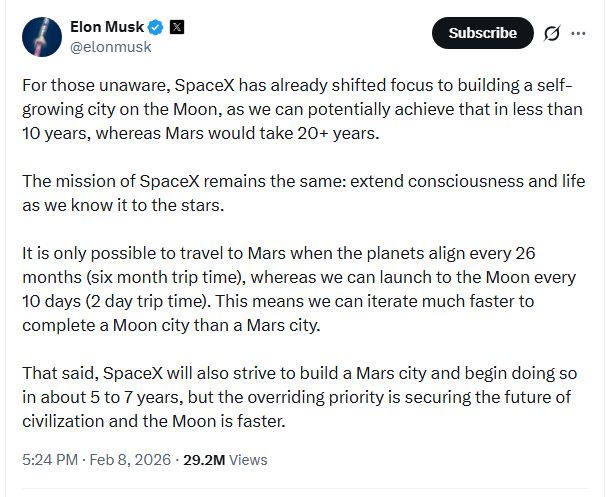
Elon Musk has announced a significant shift in SpaceX's space exploration goals, moving the company's focus from Mars to the Moon. In a recent statement on X, Musk indicated that SpaceX will prioritize establishing a human settlement on the Moon, which he refers to as a “self-growing city,” over previous plans for a Mars colony. This change marks a departure from Musk's earlier ambitions of creating a self-sustaining city on Mars, which he had previously estimated could be ready for its first settlers as early as 2024. Musk highlighted the logistical advantages of targeting the Moon first, citing factors such as launch windows and proximity to Earth. He claims that establishing a lunar city could be completed in less than 10 years, while a Mars settlement would take over 20 years. This pivot reflects a more immediate approach to human space exploration, as Musk has acknowledged that previous timelines for Mars missions have been overly optimistic. Despite the shift in focus to the Moon, Musk stated that Mars missions are not entirely off the table. He mentioned that plans for Mars could begin in 5 or 6 years and could proceed in parallel with lunar projects, although the Moon will be the initial priority. Additionally, he suggested that a manned flight to Mars might occur in 2031, indicating that while the Moon is the current focus, Mars remains a long-term goal for SpaceX. This announcement represents a major change in strategy for SpaceX, which was founded by Musk in 2002. The decision to prioritize lunar exploration over Mars reflects a recalibration of the company's ambitions in light of the challenges associated with interplanetary travel. Musk's previous estimates for Mars missions have often been criticized for being overly optimistic, and this new focus on the Moon may provide a more achievable pathway for human settlement in space.
Advertisement
Cluster Activity
Lindy Score Breakdown (V4.2)
Story Timeline
- 2026-02-09Why would Elon Musk pivot from Mars to the Moon all of a sudden? (current)
- 2026-02-11
- 2026-02-18
- 2026-02-22
Score BreakdownRisk 25
Stories gain Lindy status through source reputation, network consensus, and time survival.
Same Story from 11 sources






Breaking Similar stories








Anti-Lindy Similar stories