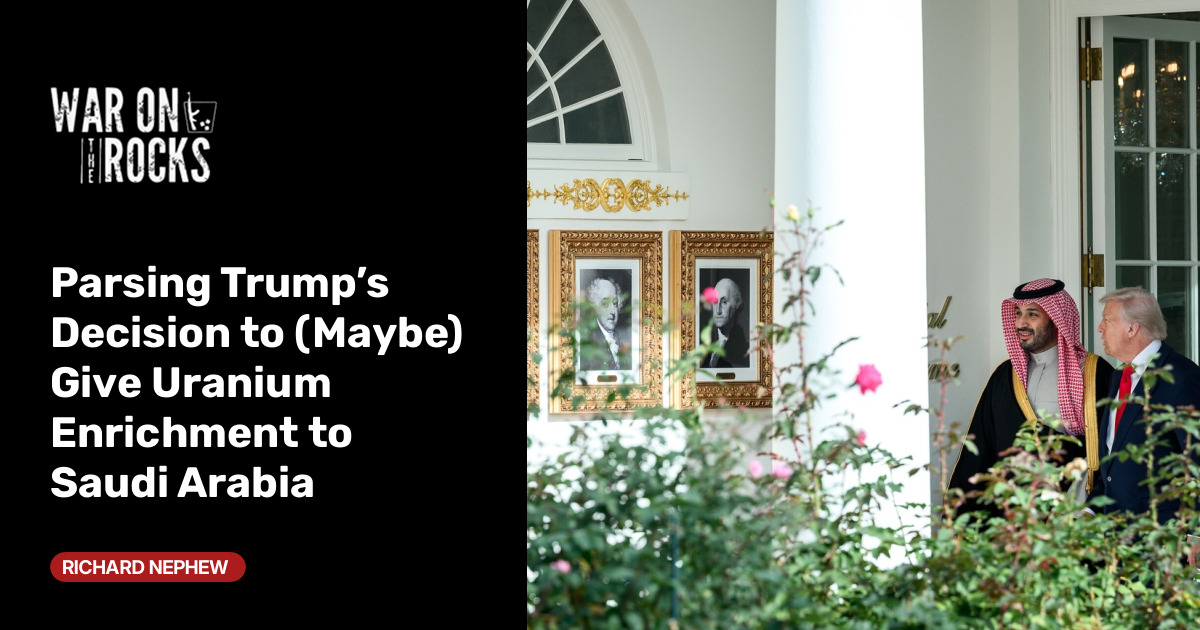
Parsing Trump’s Decision to (Maybe) Give Uranium Enrichment to Saudi Arabia
War on the Rocks • 7/29/2026
Summary
On June 22, the United States announced a landmark civilian nuclear cooperation agreement with Saudi Arabia, which is expected to last for 30 years. This agreement allows Saudi Arabia to build nuclear reactors and may permit the country to enrich uranium. The deal is part of a broader strategy aimed at establishing a multi-billion-dollar partnership between the U.S. and Saudi Arabia, which includes the involvement of U.S. firms in developing the nuclear program (The Hindu, The New York Times). The U.S. Energy Department stated that the agreements lay the legal foundation for this long-term partnership and advance several priority economic and strategic objectives, including nuclear nonproliferation. The agreements are referred to as Section 123 agreements, named after the section of the 1957 U.S. Atomic Energy Act that outlines the conditions for such cooperation. While the agreements emphasize peaceful purposes, the potential for uranium enrichment raises concerns about nuclear proliferation in the Middle East (War on the Rocks, The Hindu). Initially, the plan involves importing nuclear fuel to Saudi Arabia, but a joint two-year study will assess the value and commercial viability of local uranium enrichment. If the study supports local enrichment, U.S. companies would build and operate a uranium enrichment facility in Saudi Arabia, with safeguards to prevent the transfer of sensitive enrichment technology to the Saudis (The Hindu). The announcement has attracted attention due to its implications for regional security and energy dynamics, particularly concerning Israel and some U.S. lawmakers (BBC).
Advertisement
Lindy Score Breakdown (V4.2)
Score BreakdownRisk 50
Stories gain Lindy status through source reputation, network consensus, and time survival.
Breaking Similar stories