The Politicization of Violence and Martyrdom in Deeply Polarized Societies
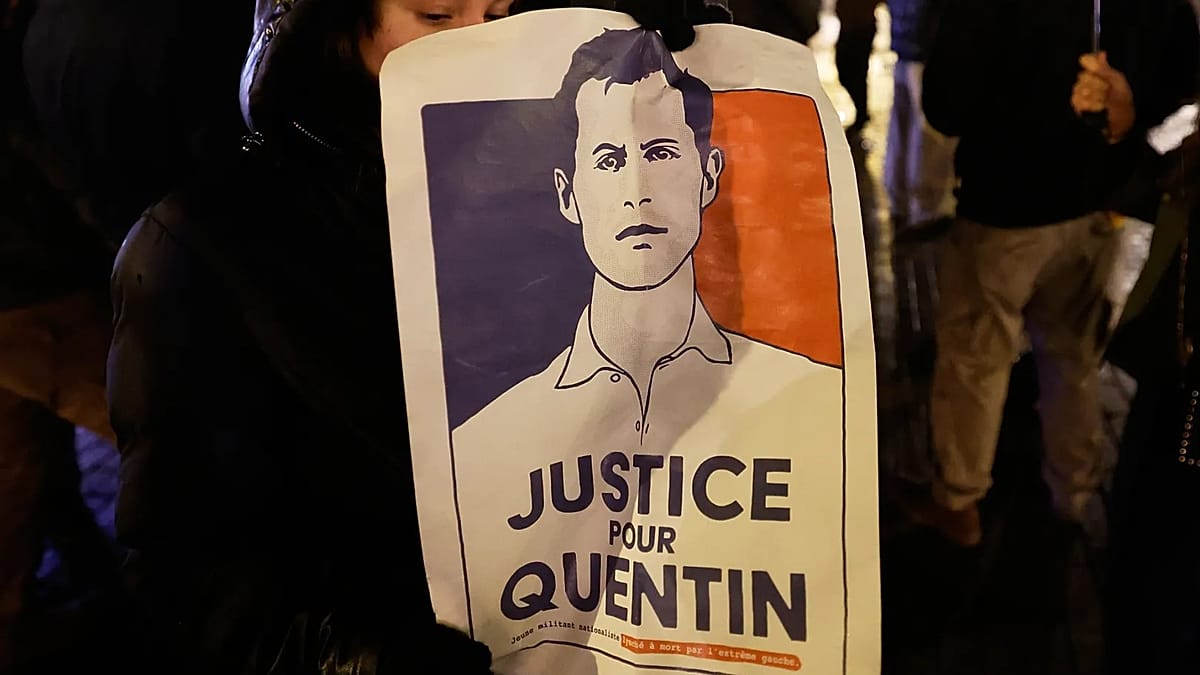
This news cluster vividly illustrates how an act of violence, specifically the fatal beating of a far-right activist during a clash with anti-fascist militants, is immediately seized upon and transformed into a political instrument by various factions. In a deeply polarized society, such an event becomes a catalyst for: 1. Martyrdom: The victim is elevated to a symbolic figure, a 'rallying cry' for their side, as seen with Deranque becoming France's 'Charlie Kirk moment.' 2. Blame-Shifting and Accusation: Political opponents are quick to assign blame, with the government accusing the hard left and the far-right leveraging the incident against their adversaries, intensifying existing political tensions. 3. Escalation of Conflict: The event fuels an 'increasingly intense' atmosphere, leading to large-scale protests, calls for calm, and concerns about rising political violence, impacting upcoming elections. 4. Information Warfare: The spread of misinformation highlights how narratives are constructed and manipulated to serve political agendas in a charged environment. This phenomenon demonstrates how violence, rather than being solely a criminal act, becomes a potent symbol and a strategic tool in the ongoing struggle between ideological extremes, further entrenching divisions and potentially escalating conflict.
The Enduring Playbook: Violence, Martyrdom, and the Lindy Effect of Polarization
The tragic death of Quentin Deranque in Lyon, a young man caught in the brutal currents of ideological clash, is not merely a criminal investigation; it is, as the news cluster vividly demonstrates, a potent political earthquake. Yet, for all its immediate shockwaves, the phenomenon unfolding around Deranque’s death is startlingly familiar. It feels like a new crisis, but in the grand sweep of human history, it’s an old script, played out with alarming regularity. This is where the wisdom of the Lindy Effect offers a sobering, if uncomfortable, perspective.
The Lindy Effect, often applied to the longevity of ideas or technologies, suggests that the longer something has survived, the longer it is likely to continue surviving. And few human behaviors have proven more enduring than the politicization of violence and the creation of martyrs in deeply fractured societies. When an individual falls victim to ideological conflict, their death rarely remains a private tragedy or a simple criminal act. Instead, it is almost immediately seized upon, transformed into a rallying cry, a symbol, a potent narrative weapon in the ongoing struggle between opposing factions. The victim becomes a martyr, their memory a banner under which supporters can unite, and their demise a cudgel with which to bludgeon political adversaries.

Consider the Boston Massacre of 1770. Five American colonists were shot and killed by British soldiers. While a legal trial ensued, the immediate aftermath was a masterclass in political weaponization. Paul Revere’s iconic engraving, depicting British soldiers firing mercilessly into an unarmed crowd, was a deliberate piece of propaganda. The victims were instantly elevated to martyrs for liberty, their blood a testament to British tyranny. Figures like Crispus Attucks, a man of mixed African and Native American descent, became a potent symbol of colonial grievance. This single act of violence, magnified and manipulated, became a foundational narrative for the burgeoning American revolutionary movement, galvanizing sentiment against the crown and laying rhetorical groundwork for war. It wasn't just a street brawl; it became a crucial turning point, fueled by a manufactured martyrdom.
Fast forward to contemporary France, and the echoes are unmistakable. Deranque’s death is swiftly labeled a "Charlie Kirk moment" for the French far-right, instantly transforming a personal tragedy into a political commodity. The government points fingers at the hard left, while the far-right leverages the incident against its adversaries. Protests erupt, calls for calm are issued amidst concerns of escalating violence, and the very fabric of upcoming elections is tinged with the incident's fallout. Information warfare rages, with narratives meticulously crafted to serve partisan agendas. It's the same old story, told with new media and faster dissemination, but the core human impulse to forge meaning, blame, and identity from tragedy remains unchanged.
So, as we observe the immediate and intense politicization of Quentin Deranque's death, we are not witnessing an anomaly, but rather the latest iteration of a Lindy-proven playbook. The question, then, is not if such events will be politicized in deeply polarized societies, but rather how societies, aware of this enduring pattern, might ever hope to break its cyclical grip, or if we are simply condemned to endlessly re-enact these tragic, yet strategically potent, dramas?