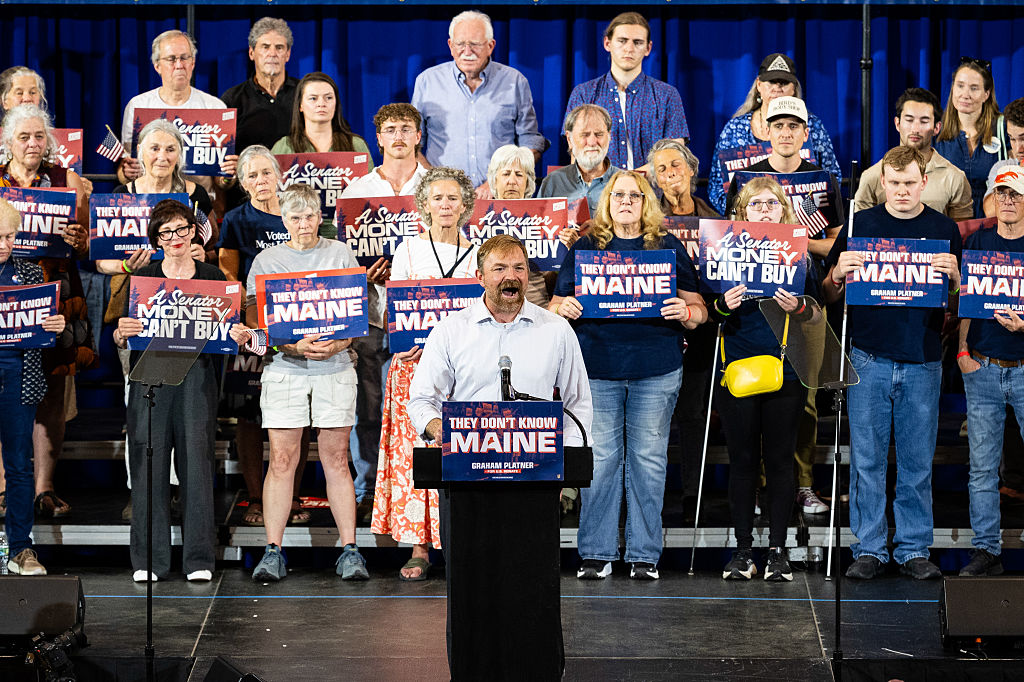
The Fragility of Political Reputation and the Succession Crisis
This news cluster vividly illustrates how a serious allegation can instantly dismantle a political figure's reputation and support, leading to their forced withdrawal from a race. This creates a profound succession crisis within their political party, which must then scramble to find a viable replacement under immense pressure, highlighting the precarious nature of public trust and political careers.
The Ephemeral Crown: When Reputation Crumbles and Succession Scrambles
The recent tumult surrounding Graham Platner, a promising candidate whose political ascendancy was abruptly halted by a serious allegation, offers a stark, contemporary lesson in an ancient truth. In mere days, a seemingly robust political career, built on public trust and party backing, can unravel, leaving behind a profound vacuum. This isn't just a political setback; it's a textbook demonstration of the exquisite fragility of political reputation and the ensuing, often chaotic, succession crisis that inevitably follows.
From a Lindy perspective, we often observe that things which have endured tend to endure longer. Ideas, institutions, even certain political ideologies, gain strength and legitimacy with age. They've weathered storms, proven their resilience, and accumulated the kind of social capital that suggests future longevity. Yet, individual political reputations, particularly in our hyper-connected age, seem to operate on an accelerated, almost anti-Lindy, clock. They can be built at warp speed through media saturation and social movements, but they can also be decimated in an instant, proving their foundations were far shallower than their apparent height suggested. A single accusation, irrespective of its immediate legal veracity, can become a political death knell, instantly dissolving years of careful cultivation.

The speed of Platner’s fall is illustrative. Endorsements evaporated, party leadership distanced themselves, and loyal voters expressed betrayal. This immediate abandonment highlights how deeply intertwined public trust is with a politician’s viability. When that trust is shattered, the political entity – in this case, a party invested in a particular candidate and his platform – is left reeling. The "scramble" for a replacement, as current events show, is not merely about finding another name; it's about desperately trying to recapture the momentum, the vision, and the voter enthusiasm that the fallen figure embodied. The party becomes "hobbled," not just by the loss of a candidate, but by the sudden, unexpected void in leadership and direction.
This phenomenon, while amplified by modern media, is far from new. Consider Alcibiades, the brilliant, charismatic, and controversial Athenian statesman and general of the 5th century BC. His reputation, though immense, was perpetually precarious. Accusations of sacrilege and profaning the Eleusinian Mysteries, emerging just as he was set to lead a crucial expedition to Sicily, shattered his standing. Despite his denials and past glories, the allegations led to his recall from command, a dramatic defection to Sparta, and later to Persia. His repeated falls from grace and subsequent exiles caused immense political and military instability for Athens, forcing constant re-evaluation of leadership and strategy, and fundamentally altering the course of the Peloponnesian War. Alcibiades’s personal reputation was so intertwined with Athens' fate that its fragility plunged the city into recurring crises of leadership and trust.
The Platner episode, therefore, is not an anomaly but a contemporary echo of an ancient pattern. It forces us to ponder: In an era where reputations can be built and destroyed with unprecedented speed, what does it mean for the long-term stability of political institutions? Can genuine, Lindy-enduring leadership truly take root when the ground beneath every public figure is so prone to sudden, cataclysmic shifts?