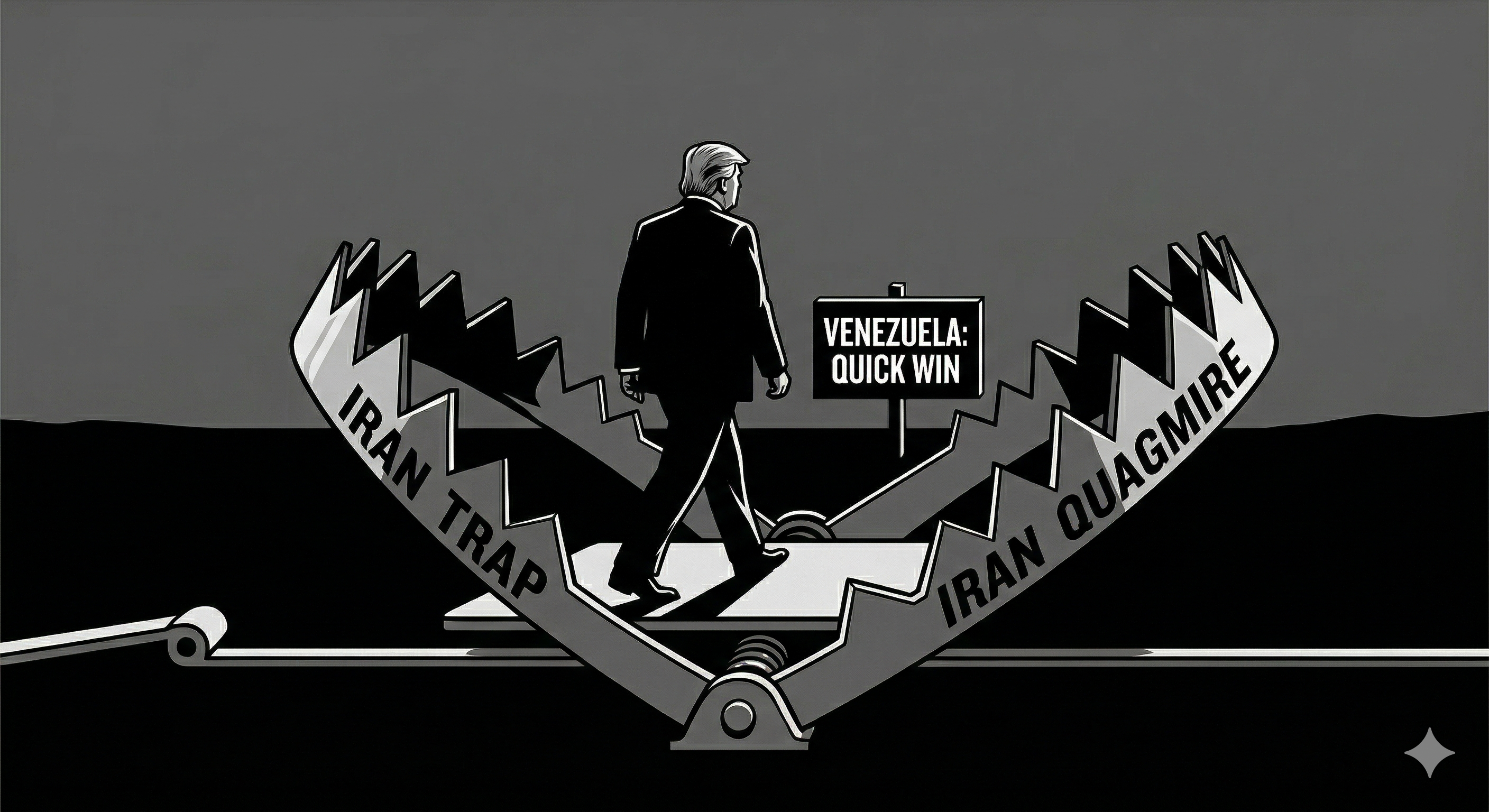
The Cost of Victory
Was Venezuela the Most Expensive US Victory?
The capture of Nicolás Maduro in January 2026 during Operation Absolute Resolve was hailed as the dawn of a new era in precision warfare. In less than 48 hours, the United States executed a near-flawless decapitation strike, removing a long-standing adversary with minimal "kinetic footprint." On the surface, it was a triumph of intelligence and technology.
But as the smoke thickens over the Middle East in this ongoing Iran War, it is becoming clear that the "surgical" success in Caracas was actually a catastrophic data point. It didn't just win a campaign; it created a lethal illusion of control.
The Mirage of the "Quick Win"
The primary danger of the Venezuela operation was its speed. In systems theory, we know that a single successful outcome can reinforce a success bias—a psychological trap where leadership begins to treat a unique, localized event as a universal template.
The "Donroe Doctrine" was born in the weeks following Maduro's capture. The logic was dangerously simple: if high-tech attrition and targeted strikes could collapse a regime in the Western Hemisphere overnight, the same "script" could be applied to a "hollowed-out" Iranian state. We mistook a specific political collapse for a general military law.
Operation Epic Fury: The Systemic Collision
When Operation Epic Fury launched on February 28, 2026, the US wasn't just fighting the Iranian military; it was fighting its own flawed mental model.
Iran is not a centralized hierarchy that collapses when the top is removed; it is a complex system of systems. It possesses geographic depth, ideological resilience, and a decentralized command structure designed specifically to survive the "Venezuela Playbook." By applying the lessons of a 48-hour victory to a landscape of immense cultural and systemic complexity, the US essentially walked into a strategic lure.
The Cost of the Illusion
In the weeks since the invasion began, the "quick win" has evolved into a high-stakes quagmire. The costs are mounting in ways that traditional balance sheets fail to capture:
Operational Attrition: The assumption that we could "control the sky" through sheer technical superiority has been met by a resilient, layered defense that prioritizes endurance over immediate engagement.The Logistical Trap: Unlike the short supply lines used in the Caribbean, the Iranian theater has stretched American logistics to a breaking point, creating vulnerabilities that weren't present in the "Venezuela template."Dynamic Complexity: Every intervention in the Iranian system has triggered unforeseen feedback loops—strengthening regional alliances and hardening domestic resistance—that the planners of Operation Absolute Resolve never had to account for.The Bottom Line
If the price of a "quick victory" in one hemisphere is the loss of strategic reality in another, then Venezuela was a bargain the US could never afford. We are now seeing the fallout of a leadership that fell in love with its own success.
The Iran War is proving that warfare cannot be reduced to a surgical procedure. By letting a "perfect" victory in Venezuela dictate our global strategy, we didn't just enter a new war—we fell for a trap built out of our own hubris. The most expensive victories are often the ones that look the easiest on paper.